A Flute Consort
Orpheus
Orpheus
Flutes
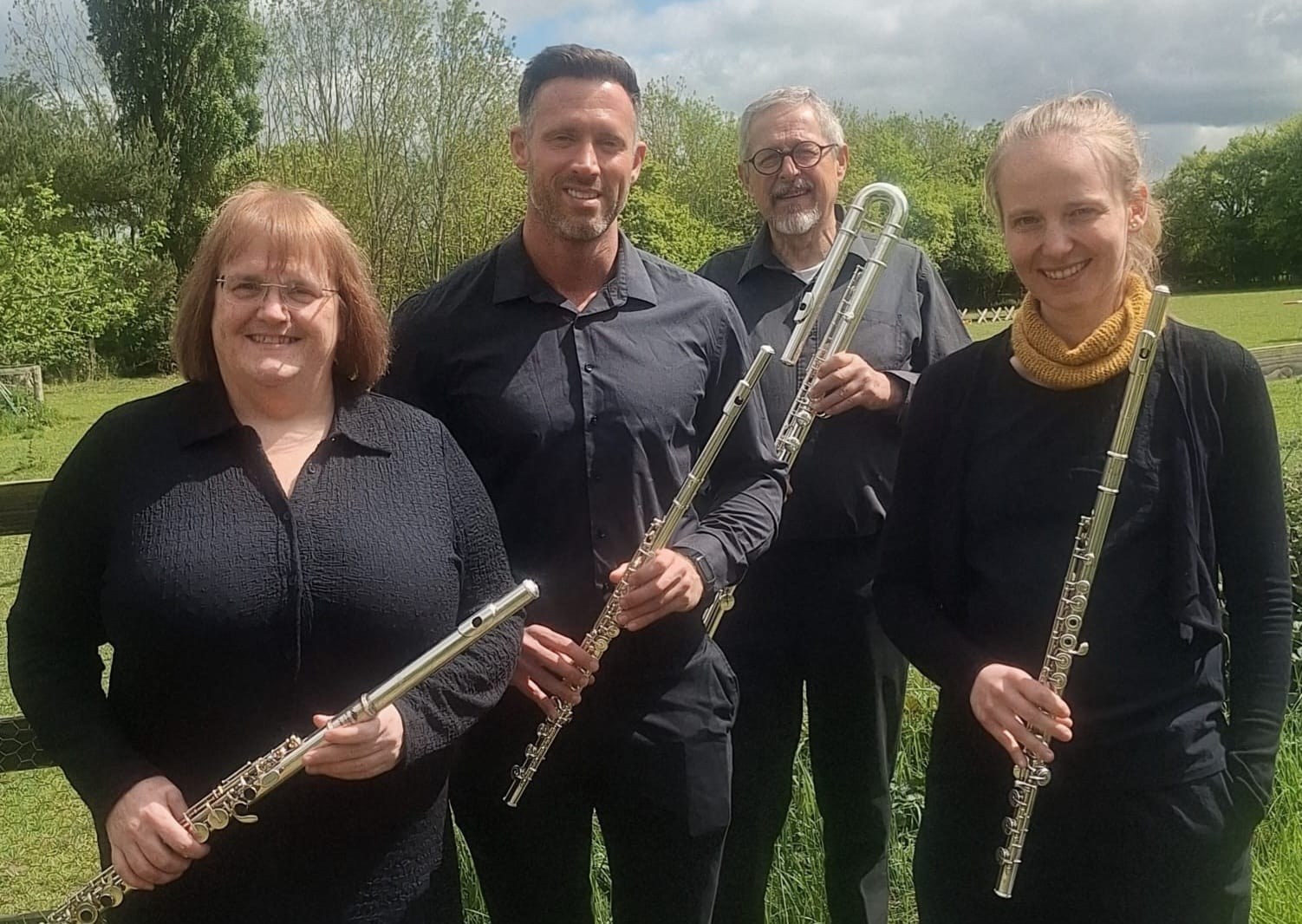
A flute quartet playing what baroque, classical and even more recent composers might have written if modern flutes had been available in their time.
A flute quartet playing what baroque, classical and even more recent composers might have written if modern flutes had been available in their time.
The flute consort — instruments of different sizes playing together — was common in the Renaissance, but after the 18th century, music written for a flute quartet became rare. Theobald Boehm brought the flute up to a modern standard in the 19th century, but the bass flute didn't yet exist: its length was limited by the reach of human arms, until the curved headjoint made a longer tube possible. Bass flutes only appeared with any success in the 1920s.
In late 2024 Orpheus Flutes was founded on a simple idea. If we take string quartet repertoire from the baroque era onwards, arrange it for a flute quartet — two concert flutes, an alto flute and a bass flute — would that work? In our work so far the answer is a resounding "yes". The group has been well received both for the originality and success of the idea as well as for the high quality of the performances.
With Mozart's Magic Flute, we went a stage further and arranged an entire opera. We weren't the first — Franz Heinrich Ehrenfried arranged it for string quartet just two years after Mozart's death, and some of our own arrangement owes a debt to his.
Like a string quartet's two violins, viola and cello, we have two concert flutes, an alto flute and a bass flute. The range isn't quite the same as a string quartet, but with work on the arrangements, much of the same repertoire can be played.
Four players, four routes into the ensemble — from period-instrument orchestras to school music departments to picking the flute back up in middle age.
An intrepid, versatile flautist performing on both modern and historical flutes with a strong attraction to chamber music. Anne has performed alongside orchestras on period instruments including the Theresia Orchestra, Britten–Pears Baroque Orchestra, the Orchestra of the Age of Enlightenment, Dunedin Consort and the London Handel Orchestra. She holds MA degrees in modern and historical flutes from the Royal Conservatoire of Brussels and the Haute École de Musique of Geneva.
Cathy grew up in Nottingham, and it was a school visit from the RPO's principal flute, Robert Winn, that set her on the path to studying music. She gained a place on the Graduate programme at Trinity College of Music, studying with Ingrid Culliford and John Bowler, and won the Harold Clarke Woodwind Prize in her first year. After freelancing and teaching around London and Hertfordshire, she moved to Norfolk, where she has taught high school music since 2000, now working with children with additional educational needs.
Daniel began his flute studies locally in King's Lynn before attending the Guildhall School of Music and Drama and Trinity College of Music. He is currently Principal Flute in the Norfolk Symphony Orchestra, performs locally with his wind quintet, The Nova Quintet, and regularly guests with local music groups and theatre productions — as well as judging youth music competitions.
Hugh started flute at school with Maija Lielausis, continuing for a few years with Evelyn Frank before work got in the way and the flute stayed in its case. He returned to it in middle age, studying with Anna Hopkins, and now plays regularly.
Arrangements for flute quartet, drawn from the classical and operatic repertoire.
A short excerpt from a recent concert
Orpheus Flute Quartet has given several performances of Mozart's opera arranged for four flutes, with Claire Lanham as narrator carrying the story between numbers.
Prince Tamino is rescued from a monster by the Three Ladies of the Queen of the Night, but the birdcatcher Papageno takes the credit — and is punished with a padlocked mouth for lying. The Ladies show Tamino a painting of the Queen's abducted daughter, Pamina; he falls in love with her image and sets out to rescue her, armed with a magic flute, while Papageno carries a set of magic bells. Papageno's blundering arrival saves Pamina from the moor Monostatos, and the pair escape using the bells to search for Tamino. Pamina and Tamino finally meet, and fall instantly in love.
Tamino and Papageno must undergo trials to join the brotherhood of the temple, beginning with a vow of silence. The Queen gives the sleeping Pamina a dagger, telling her she must kill Sarastro to regain her power — but Sarastro, aware of the plot, reminds his order that it is bound by love. Papageno glimpses his destined match, Papagena, but risks losing her if he fails his trials. Pamina and Tamino pass together through trials of fire and water, aided by the magic flute; Papageno is united with Papagena despite breaking his silence. The Queen, her Ladies and Monostatos are swept away by thunder, and the company celebrates the triumph of light over darkness.
Orpheus Flutes' first programme tells the story of Josef Mysliveček — known across Italy as "Il Boemo", the Bohemian — through his music and his friendship with the young Mozart, narrated using Mozart and Mysliveček's own letters.
Mysliveček left Prague as a young man, at a time when Bohemian composers went largely unperformed at home and international careers meant emigration. He settled in Italy, where his operas made his name and earned him the nickname "Il Boemo". There he became a close friend to the teenage Mozart, who wrote home describing him warmly to his father and sister.
The programme follows their friendship into its later, harder years: Mozart's visit to Mysliveček in Munich, where he found his friend ill, isolated, and still — in Mozart's words — "full of fire and life and genius"; and Mysliveček's own gracious reply, thanking Mozart for a kindness he felt he barely deserved.
Josef Mysliveček — Trio Sonata in B♭ major
I. Vivace II. Andante III. Allegro
Christoph Willibald Gluck — Dance of the Blessed Spirits
Wolfgang Amadeus Mozart — Divertimento in B♭ major, K. 137
I. Andante II. Allegro III. Allegro
Josef Mysliveček — Quartet in F, Op. 3
I. Allegro II. Andante III. Presto
Join us for an afternoon of Beethoven and Reicha, arranged for flute quartet.
Beethoven — Quartet in G, No. 9, arr. flute quartet
Reicha — Quartet in G Major
3.00pmWe'd love to hear from you — whether you're enquiring about a booking, a future date, or the arrangements themselves.
info@orpheusflutes.co.uk